
How I use AI to learn FAST
Because time is money and learning rate needs optimization

Hey there! I’m Robert. Welcome to a free edition of my newsletter. Every week, I share my story of building my AI startup in public, focused on hyper-personalized AI. These newsletters include my reflections on the journey, and topics such as AI, personal growth, CEO-ing, leadership, product, engineering, communication, , and more. Subscribe today to follow along.
I’ve spent THOUSANDS of dollars on courses throughout the years.
Investing in my own learning as an extracurricular has only ever paid off for me.
It’s led to:
Greater breadth and depth of skills
More income (due to higher demand skills)
More stability (can provide for family, my dog, due to more income)
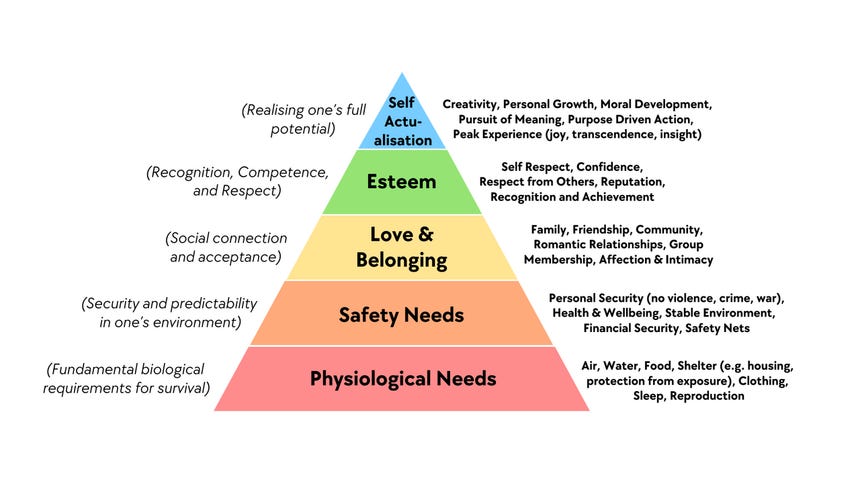
More breathing room to actualize, or in my thinking self-align, and build my dreams into reality
And learning with AI has been an insane level up in my entire life.
Why?
Because Claude Code (my AI tool of choice) does something no tool in history has done: it can teach you how to use it, while you're using it.
The tool is the teacher.
The teacher is the tool.
And the classroom is whatever you're building right now.
Last week you installed Claude Code.
Now let's talk about the fastest way to actually get good at this thing—which, it turns out, is the thing itself!
What's Inside This Week:
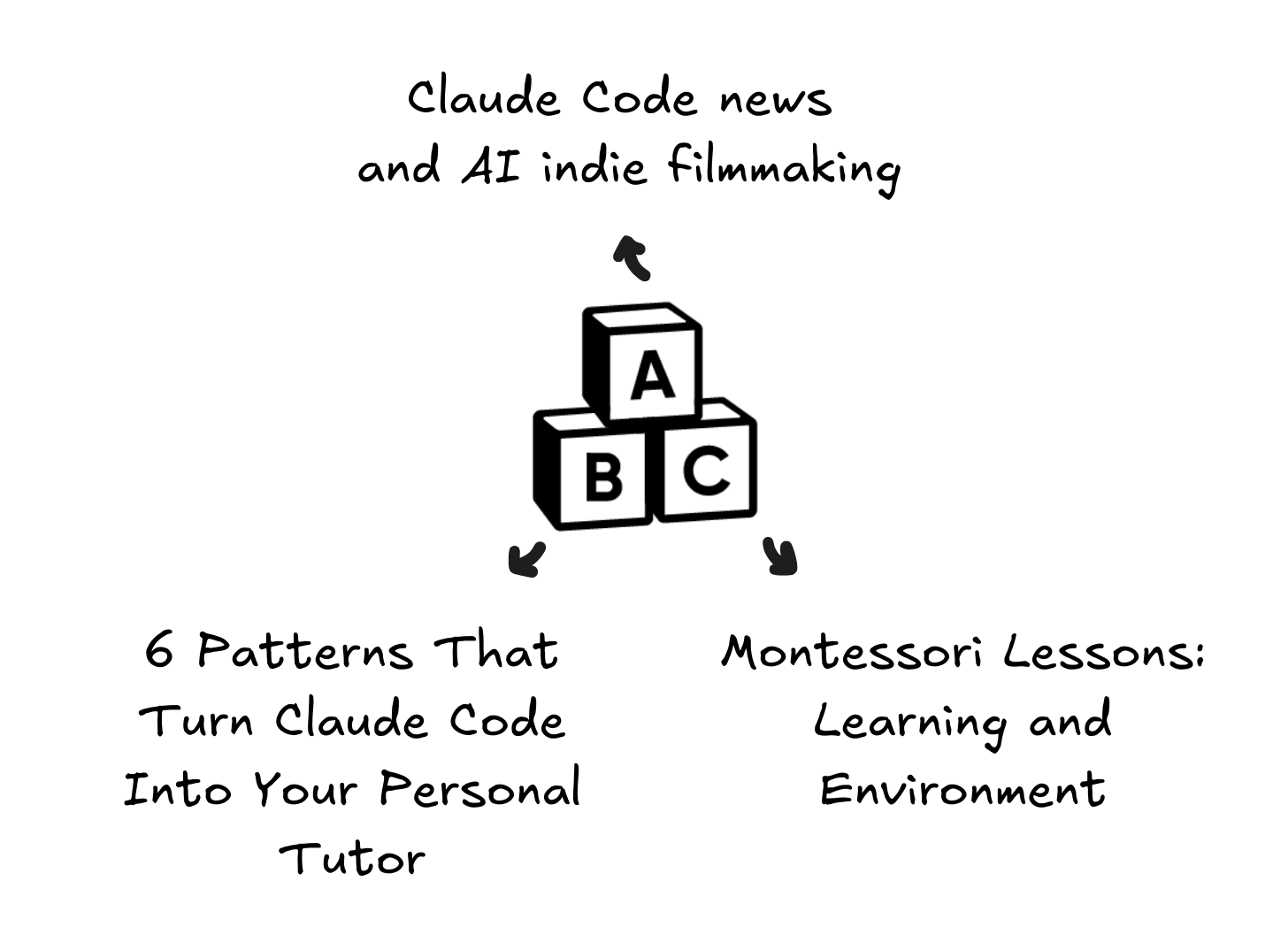
🤖 ALIGN: Claude Code news and AI indie filmmaking
🛠 BUILD: 6 conversation patterns that turn Claude Code into your personal AI tutor
✌🏼 CULTURE: What Maria Montessori figured out 100 years ago about how adults actually learn
🤖 ALIGN: Claude Code news and AI indie filmmaking
The Claude Code ecosystem is EXPLODING right now.
Claude Code now has built-in git worktree support for parallel agentic flows


AI’s promise to indie filmmakers: Faster, cheaper, lonelier
Fascinating read on the real perspectives of independent filmmakers on using AI for their craft.
“Each independent filmmaker I spoke to said that, in the case of these films, AI had enabled them to tell a story they otherwise wouldn’t have had the budget or time to tell.”
Someone made a viral Warcraft III Peon Voice Notification for Claude Code


I used to play Warcraft III, and this is EPIC. It also shows just how fast things are moving right now. This was basically a meme, that drove a new full open standard for "Coding Event Sound Pack Specification”. 😂
Software is becoming something you speak into existence

Scientific American described Claude Code as "the first tool to nail the anybody-can-do-this feeling."
This is the gap between "I have an idea" and "I have a working product" collapsing in real time.
But only if you actually learn the tool.
And the fastest way to learn it might surprise you.
The Recursive Learning Loop
I’ve learned that with the new AI tools, you don't need to know how to write code. You need to know how to direct the thing that writes code. And the only way to learn that is practice.
When you don't understand something, you ask the same tool to explain it. When you want a different approach, the same tool shows you options. When you're stuck, the same tool unsticks you.
No other tool has been its own instruction manual, study guide, and tutor. Courses are training wheels on a bike that can balance itself—if you just start pedaling.
🛠 BUILD: 6 Patterns That Turn Claude Code Into Your Personal Tutor
Let’s talk about how I actually use Claude Code to learn as I build. I’ll teach you some concepts in this article, and in future issues I’ll go super deep into use cases such as creating new greenfield projects or modernizing brownfield legacy codebases.
How to maximize learning rate
First, some theory.
There’s a fundamental meta optimization question beneath the desire to optimize the acquisition of new skills.
Can I optimize my skill acquisition rate?
Or, said more simply, how can I MAXIMIZE my learning rate?
The TLDR of the science on skill acquisition is something called deliberate practice. I write more about it here.
For the purposes of this article, we’re going to ground on the 3 F’s framework:
Focus: Deliberate practice is about targeted effort. Identify specific areas of weakness and work on them with full concentration. You’re not just doing something over and over mindlessly; you’re refining your approach every time, intentionally.
Feedback: Seek immediate feedback. Whether it’s from a coach, mentor, or even self-reflection, you need to know what you’re doing wrong to correct it. Don’t just rely on how it feels—get concrete insights into your progress.
Fix It: Integrate your learnings from the feedback and try again intentionally. Use mental representations (the mental image of what a successful performance or execution looks like) to improve.

Here, Claude Code (and yourself) are the ones giving the feedback.
And Claude Code has access to search the internet and reason.
It’s not perfect—nothing is, that’s why you have your human brain for critical reasoning and judgement. But damn have I found I’ve been able to get up and running on new domains quickly.
For example, I didn’t really know anything about capturing video testimonials dynamically from customers and having it auto update into a widget on my website. I didn’t even know where to start.
I just asked Claude Code what I should do and what key decisions I need to make, and 10 minutes later I was set up on a solution called Senja and had my testimonials up on my website.
6 Patterns That Turn Claude Code Into Your Personal Tutor
Here are 7 conversation patterns I use constantly in my Claude Code sessions. Each one turns Claude Code from "a tool I operate" into "a tool that teaches me while I operate it."
I was building Clarity and kept hitting moments where I didn't understand what Claude Code had just done.
Instead of Googling, I just... asked it.
And realized it was a better teacher than any documentation I'd ever read.
Pattern 1: "Explain What You Just Did"
After Claude Code does something complex, type:
Explain what you just did and why you chose that approach over the alternatives.This is the single highest-leverage learning move.
Claude Code explains its reasoning, names the patterns it used, and often mentions approaches it considered but rejected.
I used this when Claude Code refactored one of my files into three separate ones for a feature I was building.
I had no idea why.
The explanation taught me about separation of concerns better than any article—because it was my code, not some generic example.
The reason this works: context.
Claude Code isn't explaining the concept in the abstract.
It's explaining why your specific code benefits from this specific reorganization.
So it’s way more likely to stick.
Pattern 2: "Show Me Three Ways"
Before committing to an approach:
Show me three different ways to accomplish this, with the tradeoffs of each. Which would you recommend for my specific situation and why?Two things happen. First, you stop accepting the first solution blindly. Second, you learn that most problems have multiple valid approaches — and the "right" one depends on context.
I asked this when building our landing page. Claude Code showed me a static HTML approach, a React approach, and an Astro approach. Five minutes of reading those tradeoffs taught me more about frontend architecture than a week of tutorials.
Pattern 3: "What Does This Mean?"
When you see something you don't understand, don't skip it. Don't Google it.
LEARN WHAT THE WORDS AND THINGS MEAN!
Your future self will thank you.
What does [specific term or concept] mean in this context? Give me a few metaphors to grasp it. Explain like I'm a smart founder who doesn't code regularly.That last line matters.
Claude Code adapts its explanations to the audience you describe.
"Explain like I'm a developer" gets jargon.
"Explain like I'm a smart founder who doesn't code regularly" gets the concept without the syntax noise.
Every concept sticks better because you encountered it while building something real, not while reading a textbook.
Pattern 4: "What Should I Learn Next?"
This one surprised me the most:
Based on what we've been building together, what are the three most important things I should understand better to be more effective working with you? Be brutally honest and relate it to my goals.Claude Code analyzes your conversation patterns, identifies where you're getting stuck, and recommends specific concepts to learn.
It's a tutor who's been watching you work and knows exactly where your gaps are.
When I ran this after a week of building Clarity's content system, it told me to understand file structure conventions, git branching, and markdown formatting better.
It was dead right.
Those were my three biggest friction points.
Pattern 5: "Review My Thinking"
Before you ask Claude Code to build something, describe your plan first:
Before you build anything, here's what I'm thinking:

[Describe your approach in plain English.]

Am I thinking about this the right way? What am I missing?
This is founder mode.
You're proposing a strategy and getting feedback before execution. Claude Code tells you what's solid, what's off, and what you haven't considered.
The compounding here is enormous.
You start developing intuition without writing a single line of code. Over time, your plans get tighter and you need fewer corrections.
That's not learning to code.
That's learning to think—which is more valuable.
And you protect yourself from becoming dumber, which is happening to a lot of people using AI.
Bonus.
Pattern 6: "Teach Me the Pattern"
After something works, extract the lesson:
What we just built worked well. What's the underlying pattern here that I should recognize in future projects?

Give me the general principle, not just this specific implementation.

Abstract it into a markdown file we can reference later.
This compounds knowledge.
Instead of learning how to build one specific thing, you learn the pattern behind it.
Next time a similar problem comes up, you recognize it before Claude Code even has to explain.
I used this after building a webhook integration for Clarity. The pattern—"event-driven architecture with idempotent handlers"—turned out to apply to three other features I shipped that month.
One pattern.
Multiple applications.
Compounding knowledge.
The Meta-Lesson
The quality of your output is directly proportional to the quality of your questions.
The quality of your questions come from your curiosity and discernment.
Every time you ask "why," "what does this mean," or "how else could we do this," you're not just getting better output, you're building the skill that matters most in the AI-native era:
Knowing what to ask. And asking.
Teaching quality = Curiosity × Consistency × Context
Context, we’ll talk about next time.
Consistency is showing up daily.
Curiosity—if you're reading this newsletter, you've got plenty. (;
✌🏼 CULTURE: Montessori Lessons—Learning and Environment
She called it the "prepared environment."
You don't teach by lecturing.
You create a space where the tools are accessible, the challenges are appropriately scaled, and the learner directs their own exploration. The teacher observes, responds to questions, and occasionally redirects.
Sound familiar?
Claude Code is a prepared environment.
The tools are in your terminal.
The challenges are appropriately scaled: you set the scope by choosing what to build.
The "teacher" responds to your questions, adapts to your level, and lets you direct your own exploration.
Montessori also discovered that people learn fastest when working on something that matters to them.
Not worksheets.
Not someone else's tutorial project.
Real work with real stakes.
This is why every founder I know who's gotten genuinely good at Claude Code did it by building their actual product.
When the stakes are real, the learning sticks.
The tutorial industrial complex (did I just make this up?) wants you to believe learning happens in controlled environments: classrooms, courses, bootcamps. Montessori knew better.
And now, for the first time, adults have an AI tutor patient enough to meet them wherever they are.
You don't need to finish a course first.
You need a project you care about, a tool that can teach while it builds, and the willingness to ask questions without shame.
The classroom is your terminal.
Class is in session whenever you open it and work on something you care about.
You got this! I believe in you.
Keep building.
Best,
Robert
What I Did This Week
On a personal note, it’s been a bit up and down for me emotionally and mentally as I stretch myself in growing the business and deal with family health stress.
Making progress on all fronts, and I am in general grateful for my health, opportunities, and honestly just grounding on being alive lately. This has caused me to slip up on my content game lately, including the newsletter where I haven’t been bringing my A+ game.
Startup: For the business, the big growth edge for me has been negotiating and closing big six figure contracts. I have only done a few of those, so it’s still a new thing for me. Will report back what I learn in future issues!
Dog Dad: Kenji has been an amazing boy. He’s so good now and it’s almost his birthday in mid March! I’m so proud of how his training is going—everyone I meet thinks he’s such a great dog. But this week, Kenji had a ton of diarrhea. I was so sad for him, he had never had ANY potty accidents in the house and then this week he pooped in his crate multiple times. He was so embarassed! I felt bad for my little guy. Look at him.

Physical health: I also realized I’ve likely been iron deficient or even anemic since I started ultrarunning about 8 months ago. I realized this because I was starting to lose some hair 😱😱😱 I thought perhaps I was just getting old until I talked about it with a friend and they started telling me about their iron anemia.
WTF the body is so weird.
Running blood tests soon. This was a good wake up call because even though I’ve been thinking I’m super healthy (training for a 100 mile race, training 1 arm pullups), even one pillar of health being unstable can really mess things up.
Here are some of the symptoms I’ve been dealing with the past 6 months that I’m only now realizing are related to the intersection of my veganism, stress, and training regime towards my goals:
Losing hair
Fatigue and weakness
Shortness of breath
Inflamed tongue
Cold hands and feet
Rapid or irregular heartbeat
Restless leg syndrome
Hard time sleeping even if I’ve really worked myself
I’m now on it with liquid iron, which is the best way I’ve read to get your iron levels healthy again.
Keeping positive: somehow, even with this iron issue, I’ve managed to make decent progress on my big goals—$10M ARR, climb V10, run a 100 mile race.
And this is all without true recovery! So my thinking is once I regulate and really allow my body to adapt and recover from the stress I’ve stimulated it with, I’ll be going even faster/stronger than before!
Glass is always half full 💪😊
Liked this article?
💚 Click the like button.
Feedback or addition?
💬 Add a comment.
Know someone that would find this helpful?
🔁 Share this post.
P.S. Want reminders on entrepreneurship, growth, leadership, empathy, and product?
Follow me on..
Take care of yourself Robert! You’re doing a crazy lot and doing so well. Thanks for all the great advice with Claude Code too. I hope Kenji gets better soon with his diarrhea… my husky had that chronically and it was very sad. They do feel so embarrassed about it too. 🥺❤️