
Hey there! I’m Robert, CEO and co-founder of Clarity. Every week I share signal from the noise on AI, building, and becoming.
I sat in a room with an enterprise customer who has 2,000+ engineers, designers, and product managers.
One of them asked the question everyone was thinking.
“Am I training my replacement?”
That fear is not paranoia.
Cloudflare just cut 1,100 people and called them “measurers.”
But the fear clouds what is actually happening to product teams right now.
If you are a head of product, a head of engineering, a PM, a designer, or an engineer shipping software, this one is for you.
Your org chart is dissolving.
The boundaries around traditional software roles are blurring.
That is the good news.
What’s Inside This Week:
- 🤖 ALIGN: Boris Cherny’s five archetypes, the OpenAI Codex lead’s “zone defense,” and Cloudflare’s measurers
- 🛠 BUILD: A five-era timeline of the product-role recomposition, plus a tactical framework to lead it
- ✌🏼 CULTURE: The Florentine workshop where an apprentice made the master lay down his brush
🤖 ALIGN: 5 signals the product-team org chart is dissolving
The most interesting things I found this week in AI.
Claude Code’s Creator Just Mapped Every Tech Role to Five Archetypes
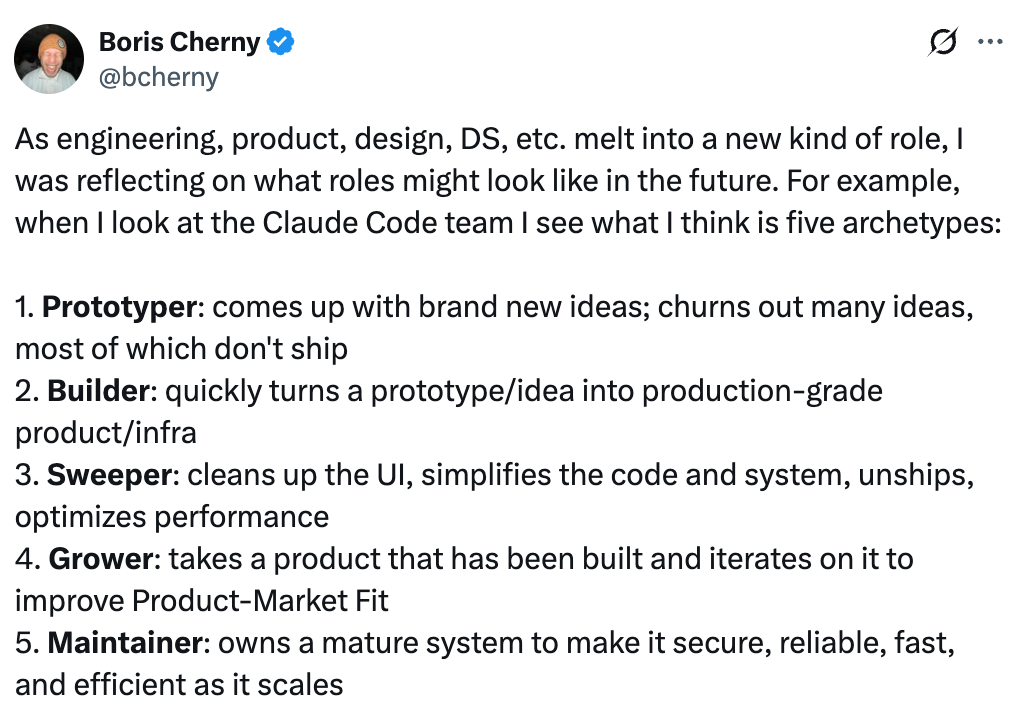
Boris Cherny looked at the Claude Code team and saw five archetypes that cut across job titles: prototyper, builder, sweeper, grower, maintainer. Some designers are prototypers. Some engineers are sweepers. The title stopped predicting the work.
Robert’s Take: This is the cleanest language I have seen for what every exec I talk to is fumbling toward. Print it out. Take it to your next career-framework conversation. The teams that name these archetypes will move their people. The ones that do not will watch their best people leave for teams that do.
The OpenAI Codex Lead Runs His Team on “Zone Defense” Now
Andrew Ambrosino leads the Codex desktop app. On Lenny’s he described collapsing PM, design, and data science into lean pods of generalists who play “zone defense” because everyone can build anything.
Robert’s Take: Jonathan flagged this episode the same week Boris posted. Two Frontier Labs, same signal, zero coordination (I assume). When Anthropic and OpenAI independently rebuild their product teams the same way, that is not a trend. That is the shape of the thing arriving.
Cloudflare Cut 1,100 People and Sorted the Survivors Into Three Buckets
Matthew Prince split his workforce into Drucker’s builders, sellers, and measurers, then aimed the cuts at the measurers: finance, compliance, middle management, internal audit. Revenue hit a record the same quarter.
Robert’s Take: Prince did not cut R&D. He cut the measurer function, the operational overhead AI now handles. Your product, design, and engineering judgment is not on that list. He even said he expects more employees in 2027 than any point in 2026. The story is recomposition wearing a layoff headline.
Half of Product Managers Are in Trouble, According to a Meta and Google Vet
Nikhyl Singhal argues the PMs who survive are the ones who stop managing backlogs and start doing the ambiguous, high-judgment work AI cannot fake.
Robert’s Take: IMO the PMs who thrive are the ones who can assert taste across different tasks (more on that in BUILD). Guard that. Compound it.
Claude Cowork Is Moving to the Cloud So Your Agents Run While You Sleep
Anthropic is lifting Cowork off your laptop and into the cloud, so agents keep working across devices even when yours is off. Max subscribers get first access.
Robert’s Take: The moment your agents run without you at the keyboard, the job stops being “operate the tool” and becomes “design what the tool does while you sleep.” That is a harness problem, and the teams treating it like one will pull away fast.
🛠 BUILD: how product-team roles recompose in the AI era
Here’s my context to give you a lens on what informs my perspective…
We are pre product-market-fit at Clarity.
We have a few B2B services customers ranging from YC series A startup to $2B established company.
We are operating as forward deployed engineers running AI native services to fund runway, and reinvest margin into a venture scale AI product using our early customers to accelerate learning.
We ship every day.
**So here’s the truth: **ALL founders, builders, tech execs, and individual contributors are living through an insane amount of change. And nobody has 100% figured it out. Everyone is in the process of figuring it out.
And the messy middle feels BAD.
Engineers, product managers, and designers have a real healthy fear of the future. A company’s job is to help talent see a future together.
Right now, I don’t see enough work done here.
So here are some of my thoughts for the people working in software that are uncertain about the future and their place in it.
Let’s talk about product management, the most cross-functional role.
Backlog junkie no more
The traditional PM job was built on one assumption: engineering time is expensive.
Measure twice, cut once.
So the PM became the backlog junkie in ADDITION to the strategic decision maker. Write the tickets. Map the dependencies. Chase the acceptance criteria.
Nobody gave you credit for it, but if you skipped it, the whole thing fell apart.
Coach Wooden at UCLA made his players practice tying their shoes to even start to play basketball.
The backlog junkie work you had to do, was the equivalent to tying your shoes here.
Now AI tools like Claude Code can tie your shoes for you. You can take a transcript from sprint planning/refinement and have AI help manage the backlog.
That should feel like a gift.
Instead to some it feels like a threat, because if the AI does the fundamentals, the quiet fear creeps in.
“Am I training my replacement?”
I have watched two camps form around that fear.
One camp says fire the PMs and designers, do more with fewer people.
The other camp says AI is coming for every job.
From my perspective, both are wrong.
The framework: focus on tasks to drive goals, not job titles
Job titles were a useful concept to bundle together skills and capabilities and deliverables required of a person.
Now, AI is empowering what Jonathan and I have been describing as role dissolution.
If you work in product you already understand the Jobs To Be Done framework by Bob Moesta.
Think about it this way: what JTBDs has the company hired people to do, in service of the company’s goals?
Learn and discover what to build.
Build it. Test it.
Deliver it. Support it.
Repeat.
Underneath these are tasks.
With AI, engineers, designers, and product managers can do all of these to varying levels.
There is a useful economics paper by Daron Acemoglu, David Autor, and Simon Johnson on pro-worker AI.
They break every technology into how it hits a given task:
It can retain human judgment.
It can augment the human.
It can automate the task.
Or it can create a brand new task.
Only that last channel, new task creation, is unambiguously good for the worker.
So run the audit.
Take every task your team does. Sort each one into a channel.
- Retained. The human still makes this call. Empathetic customer interviews. The judgment of what to build. Taste. Protect these. They are your moat.
- Augmented. The human plus AI does it faster. Writing PRDs. Prototyping. Do more of these than you could before.
- Automated. The AI does it now. First-pass PR review. Dependency mapping. Let it go.
- New task. The thing you could never do before. Parallel prototyping. Fleet orchestration. This is where your attention should live.
Things get automated, and new tasks arrive to fill the freed capacity.
How software product team roles recompose into five archetypes
On our recent podcast, Jonathan mapped this research to Boris’s five archetypes.
- The PM recomposes toward prototyper and grower.
- The engineer recomposes toward builder, sweeper, maintainer.
- The designer recomposes toward prototyper and sweeper.
- The mix you need depends on the product stage. Pre-PMF leans prototyper, builder, sweeper. Growing leans builder, sweeper, grower. Strong PMF leans sweeper, grower, maintainer, with some builder.
Watch the same product team recompose across five eras of AI.
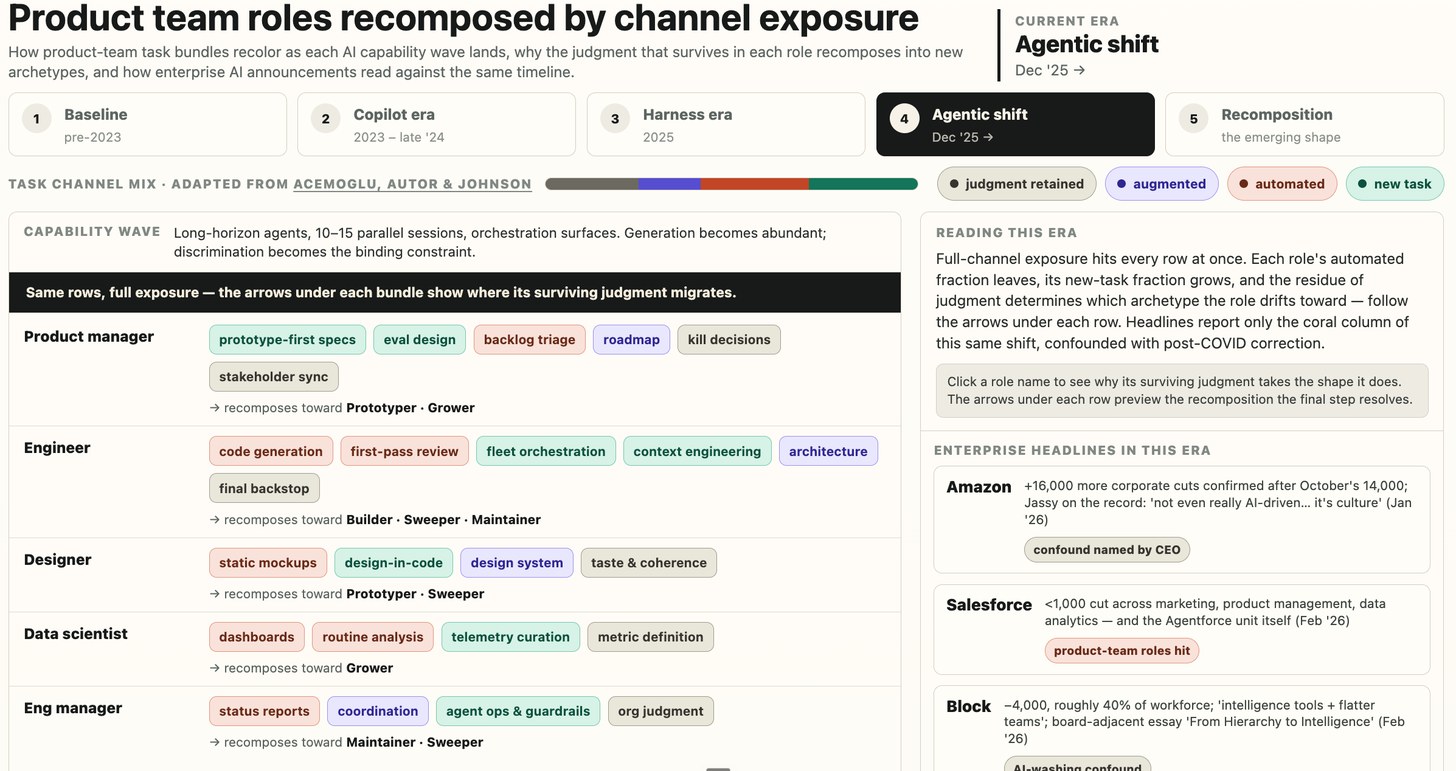
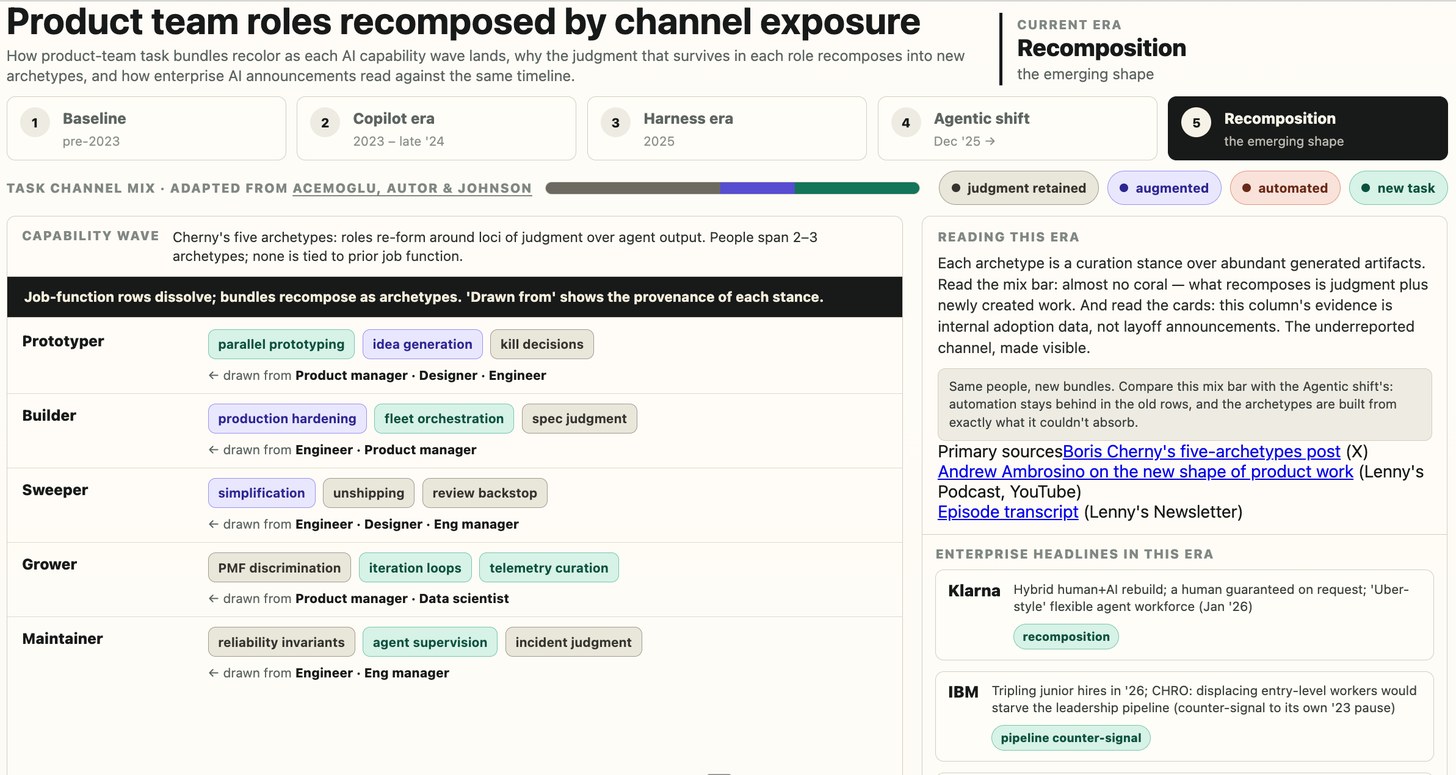
Jonathan built this. Each capability wave recolors the work. Gray is human judgment. Purple is augmented. Red is automated. Green is a brand-new task that did not exist before.
The analysis and projected evolution are clear, and mirrors my own lived experience being an AI founder and builder during this time.
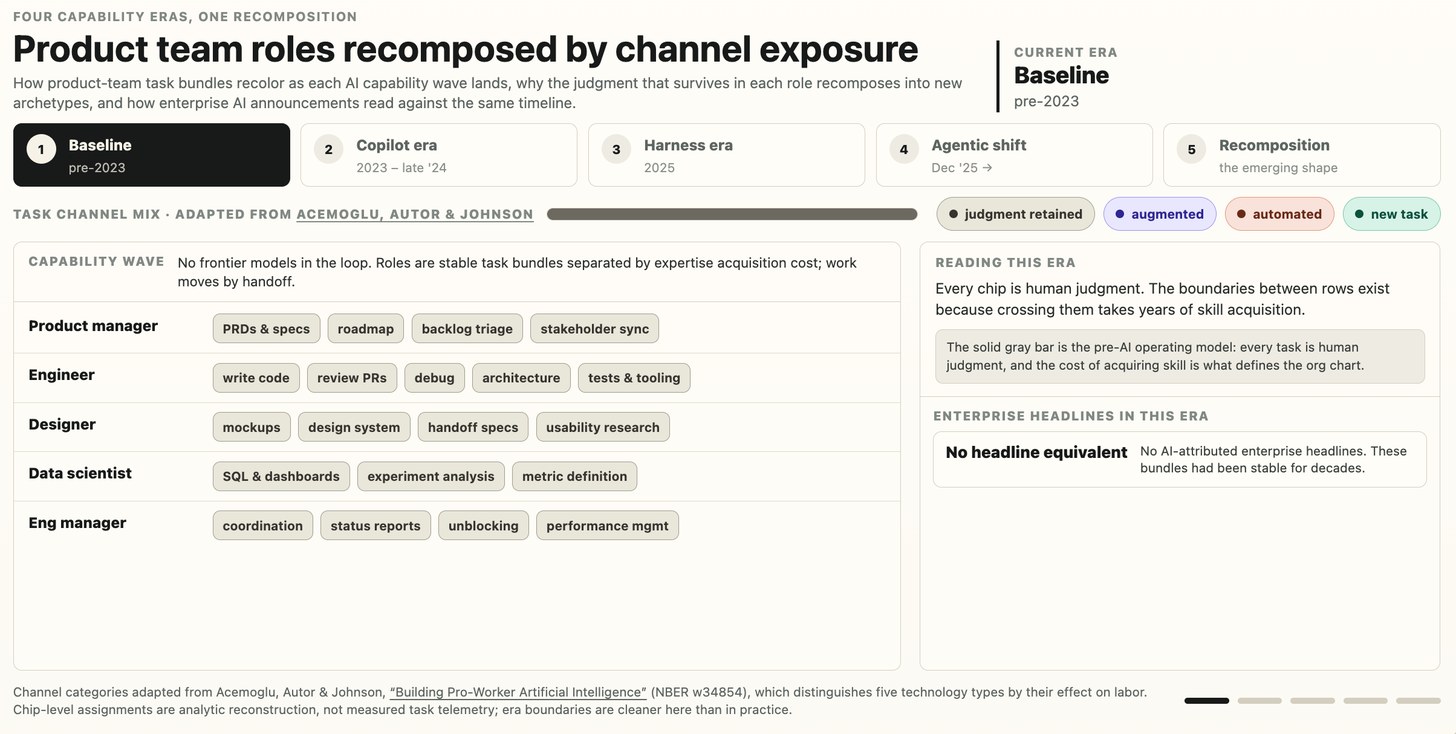
From Baseline to the Copilot era:
- The engineer’s bundle picks up its first augmented task. Every other role stays fully human.
- Automation shows up in the enterprise headlines first, in support and back office, not on the product team.
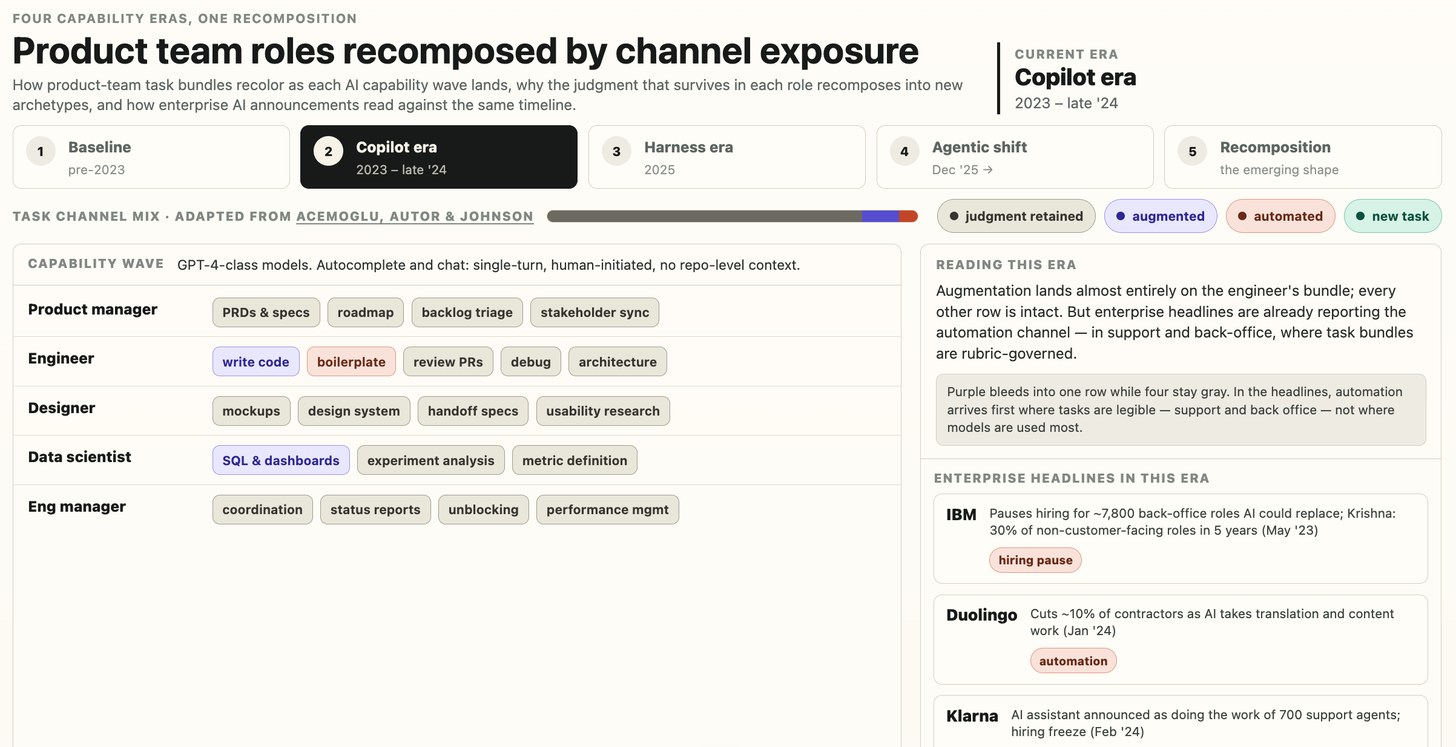
From Copilot to the Harness era:
- Repo context, tool use, and model-run PR review arrive. First-pass review and dependency mapping start to automate.
- Expertise-leveling kicks in. The designer ships code, the PM prototypes instead of writing PRDs. Role boundaries blur.
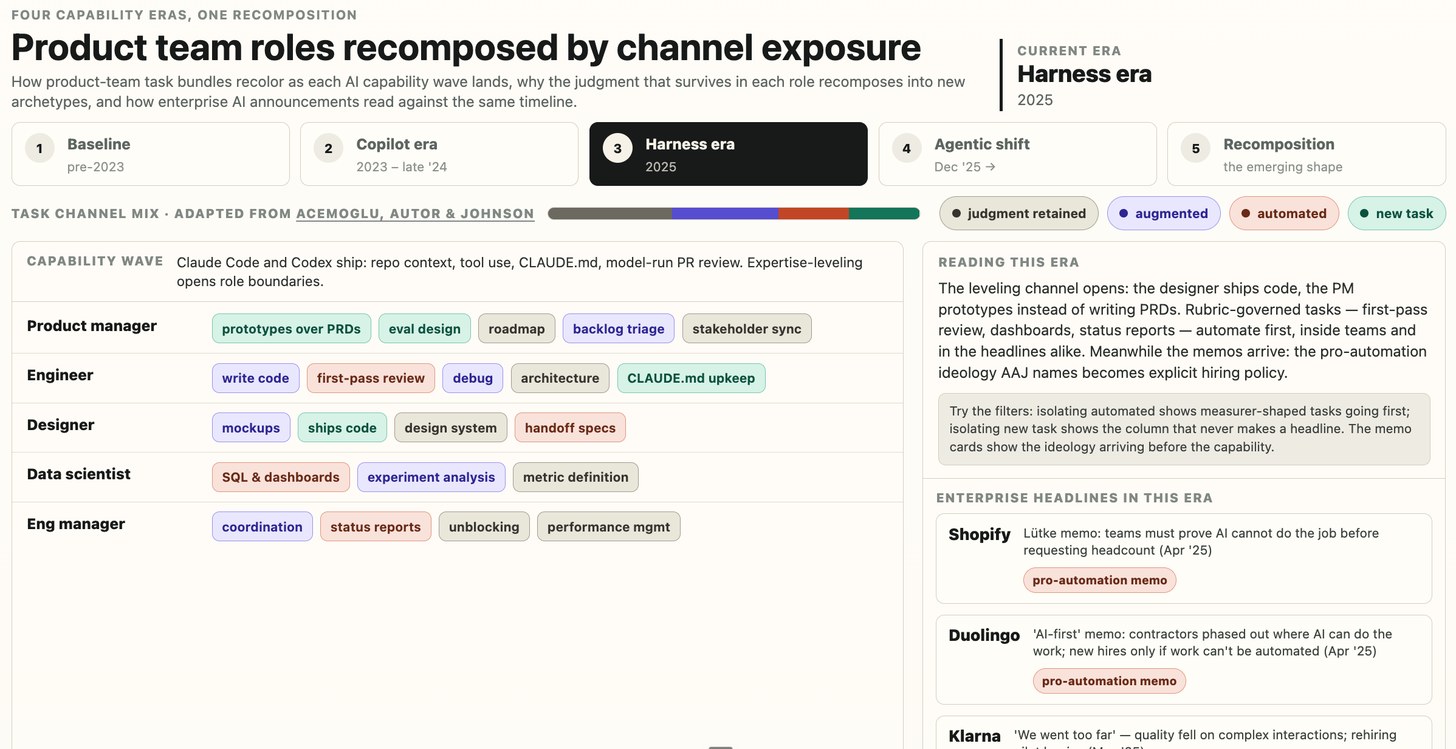
From the Harness era to the Agentic shift:
- Agents run long-horizon across 10 to 15 parallel sessions. Generation gets cheap, and judging the output becomes the bottleneck.
- Every role sheds an automated task and picks up a new one: fleet orchestration, context engineering, agent supervision.
From the Agentic shift to Recomposition:
- Job-function rows stop predicting the work. What is left of each role is a stance of judgment over agent output.
- Those stances recompose into five archetypes: prototyper, builder, sweeper, grower, maintainer. People span two or three.
The tension nobody warns you about: prototypers fork, builders can’t
Last week Fable caught something in our own work. It flagged that we kept forking off the main path by accident, three times. Then it pointed at a ticket where I had spun up 10 divergent prototypes and called the divergence a distraction.
I told Jonathan to have it read Boris’s tweet.
“Read your creator’s article, bro.”
That was me wearing the prototyper hat, and a prototyper is supposed to fork. A lot.
You are hunting for where the utility is.
The builder is the one who cannot fork, who has to wrap control plane on control plane and hold the contract still so the thing compounds.
You do not build a real product if the data model changes every hour.
You compound nothing if the contract never stops moving.
What this means practically speaking for product teams: be rigorous about scope commitments every sprint. Be in constant communication around scope changes.
I remember when I was a younger product manager, I realized that too much talking about ideas would distract the engineering team from shipping the current thing we agreed on shipping.
Good, reliable execution required rigor in all limited resources.
And there is a limited resource beyond story points:
Attention capital.
Your engineers are now having to steer dozens of autonomous agent sessions. Their attention is more limited than ever (not to even mention the Tiktokification of the world).
And in product land, you must focus. Competition is fierce, especially now.
Commit to locked scope to compound the product, and get rigorous about naming when it changes. Make those decisions intentionally as a team, constantly.
And remember: innovation land is separate from the sprint.
We are not perfect at this. We feel the friction every week with everything evolving so quickly in the AI era.
But that separation is the thing keeping us shippable.
Key Takeaways: how AI is reshaping product-team roles
- Roles are recomposing, not disappearing. The layoff headlines cut measurers, the operational overhead. Product, design, and engineering judgment is the part AI amplifies.
- Audit tasks by channel, not by title. Sort every task into retained, augmented, automated, or new. Only new-task creation is unambiguously good for the worker.
- Protect the retained channel. Taste, empathetic customer interviews, and the judgment of what to build are your moat. Guard them, compound them.
- Map the surviving judgment to the five archetypes. PM to prototyper and grower. Engineer to builder, sweeper, maintainer. Designer to prototyper and sweeper.
- Match the archetype mix to your product stage. Pre-PMF leans prototyper, builder, sweeper. Growing leans builder, sweeper, grower. Strong PMF leans sweeper, grower, maintainer, with some builder.
- Separate innovation from sprint scope. Prototypers fork, builders hold the contract still. Lock scope, name changes intentionally, and protect your team’s attention capital.
- If you lean in, you write the roles. The people at the frontier of these tools define the job descriptions of the next era.
Build In Public
This is where I tell you what is actually going on with the business and my life. Real, unfiltered.
I’ve taken a bit of a hiatus in my newsletter regularity recently. Been swamped with many things and have not made time for this as I should. Here’s a quick update behind the scenes.
Work
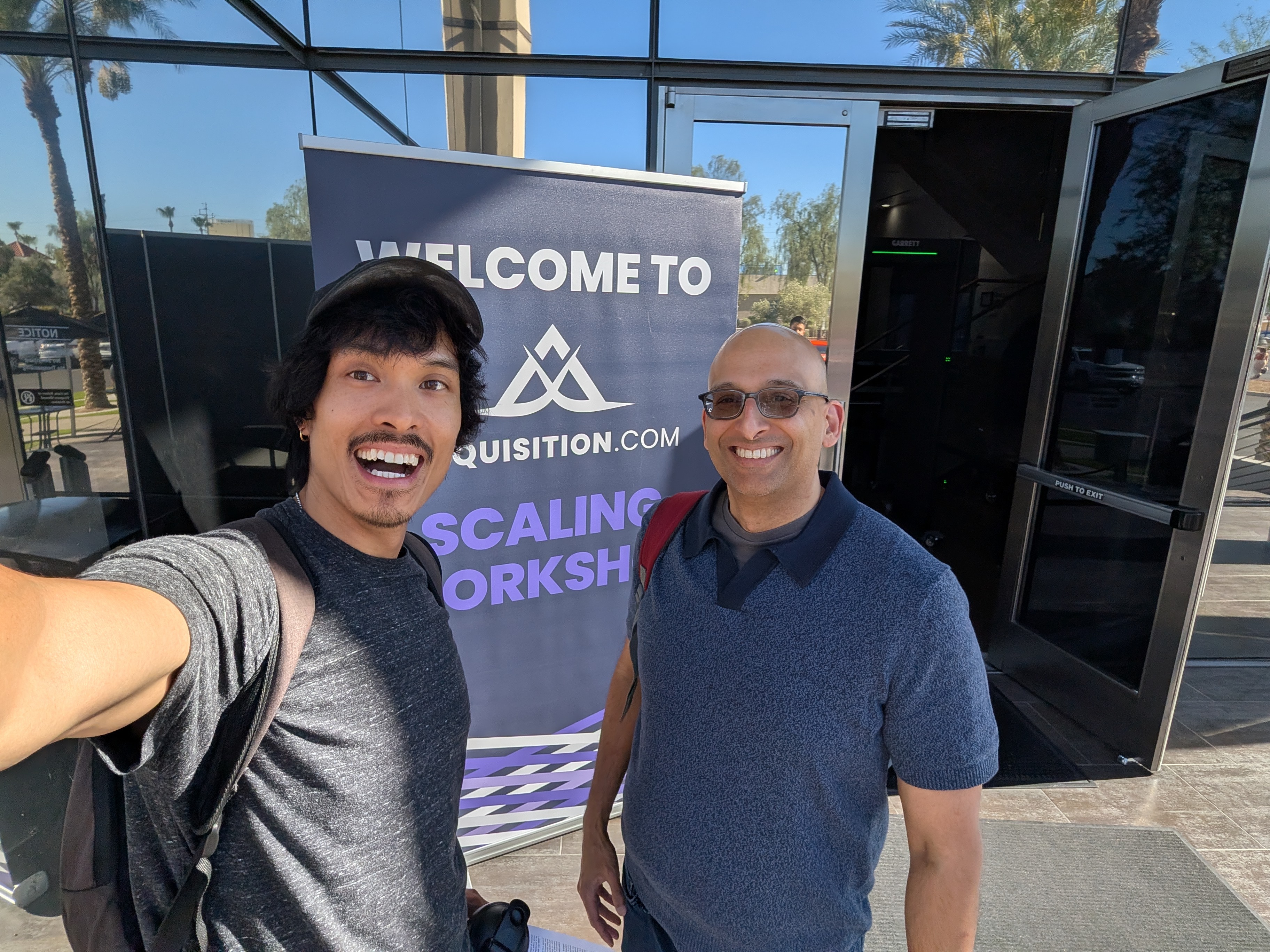
I recently attended Alex and Leila Hormozi’s Acquisition.com workshop with my buddy Hamel Husain—the best in the game at AI Evals. He’s taught over 100+ Anthropic and OpenAI engineers how to build better AI.
Highly recommend his course and blog.
I learned a ton, and really felt like I definitely leveled up my CEO thinking in terms of overall business vision and details around sales and marketing strategy.
Further more, I got positive validation from their team on the business model (current state and target future state), and got expert advice with suggested immediate tweaks/actions I can take to systemize my business in these early stages to reduce risk in enterprise value.
Things like: key man risk, client risk, channel risk, etc. so that as I make decisions to allocate resources to get a flywheel of capital I’m making these decisions from good business principles.
I met lots of team members there and thought everybody was a killer! They’ve put together such an impressive team.
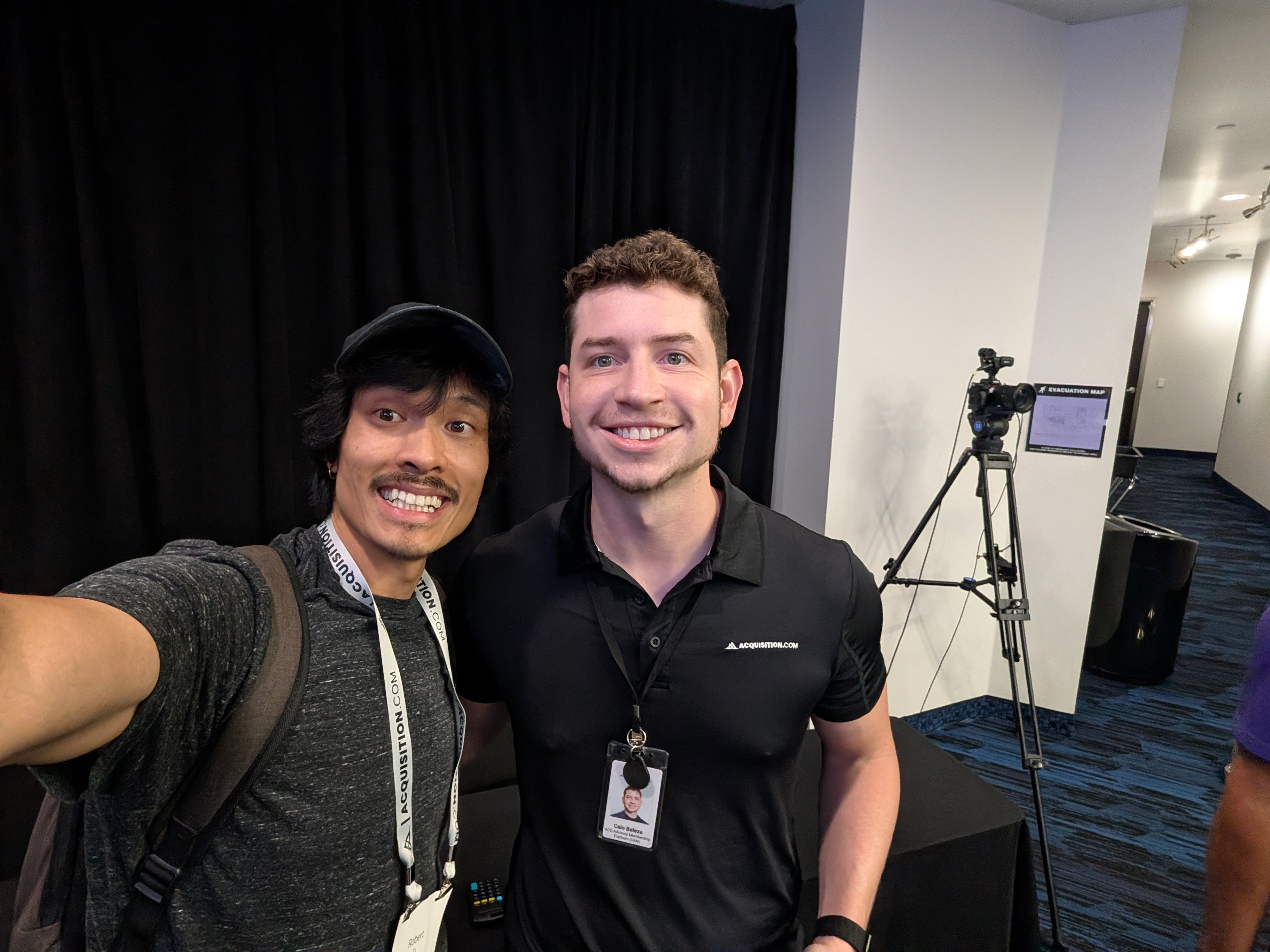
I met the President of Acquisition.com’s ACQ Vantage, Caio, and we instantly connected on our respective founder backgrounds and journeys.
I also met Kevin Gong, someone who I’ve interacted with quite a bit online in Hormozi’s community but never actually met in person. So good to meet face to face!
This guy is a legend and one of the best community oriented people I’ve ever met.
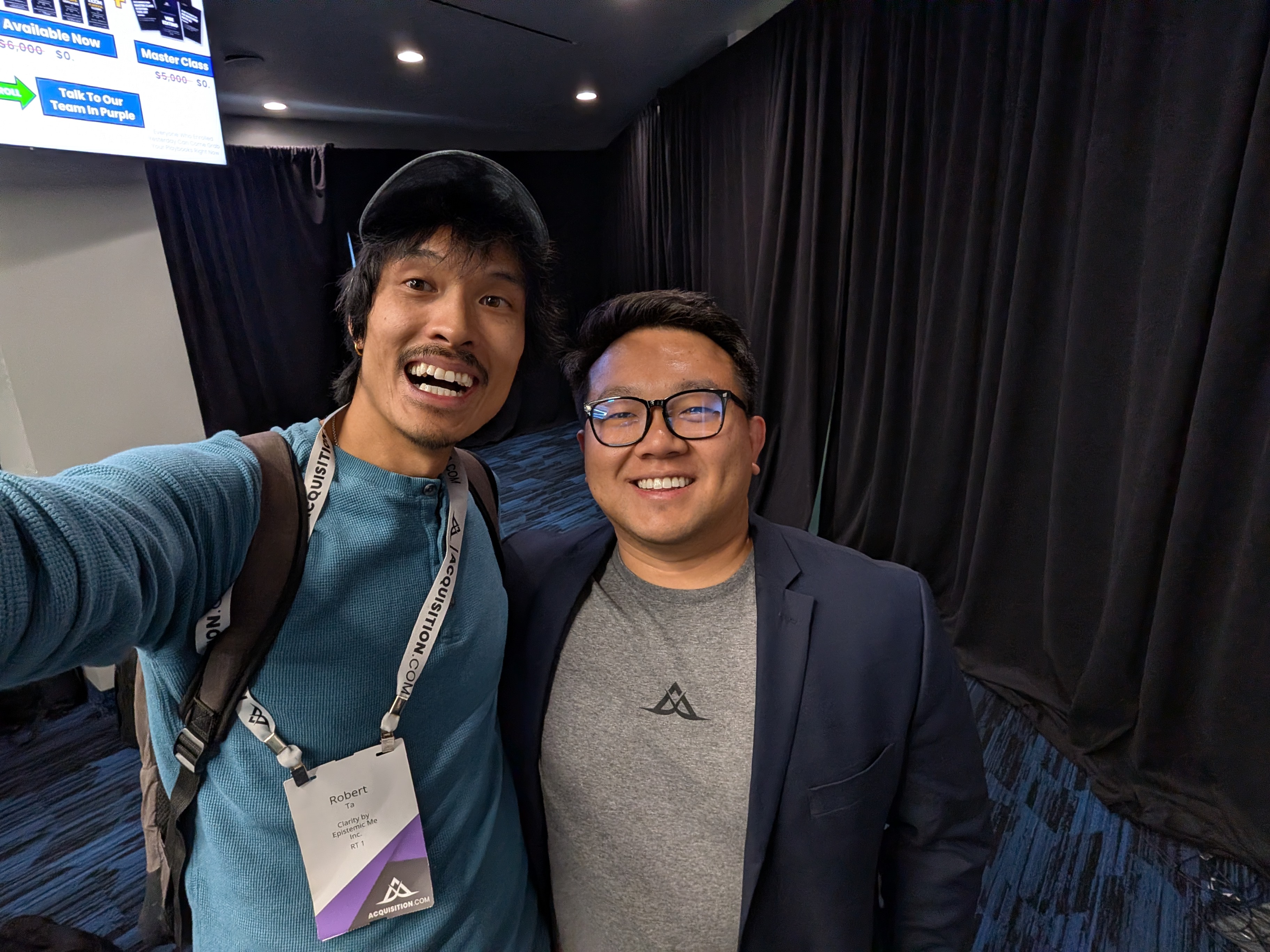
If I had just one principle to take away that I’ll be thinking about constantly, it would be this:
Being a good CEO means thinking and acting as an investor to solve the right problems the right way.
This means correctly identifying the number one business constraint at any point in time, and allocating more resources to solving that constraint.
This means I need to obsess over prioritization and execution.
Towards that Jonathan and I have been getting more rigorous about our sprint ceremonies to improve our cycle time and work quality.
We can ALWAYS optimize more.
Side Quests
V10 Bouldering
Been climbing a lot more fluidly lately, after coming back from an intercostals rib area injury.
I’m feeling lucky to just get back on real rock lately too.
100 Mile Ultra
It was my 34th birthday a couple weeks ago, on June 28th.
I decided the day before I would try for an ultra on my birthday, 1 mile for every year alive. So 34 miles, minimum. I also decided I would go for 50 miles.
Big milestone to get to my 100 mile ultra goal.
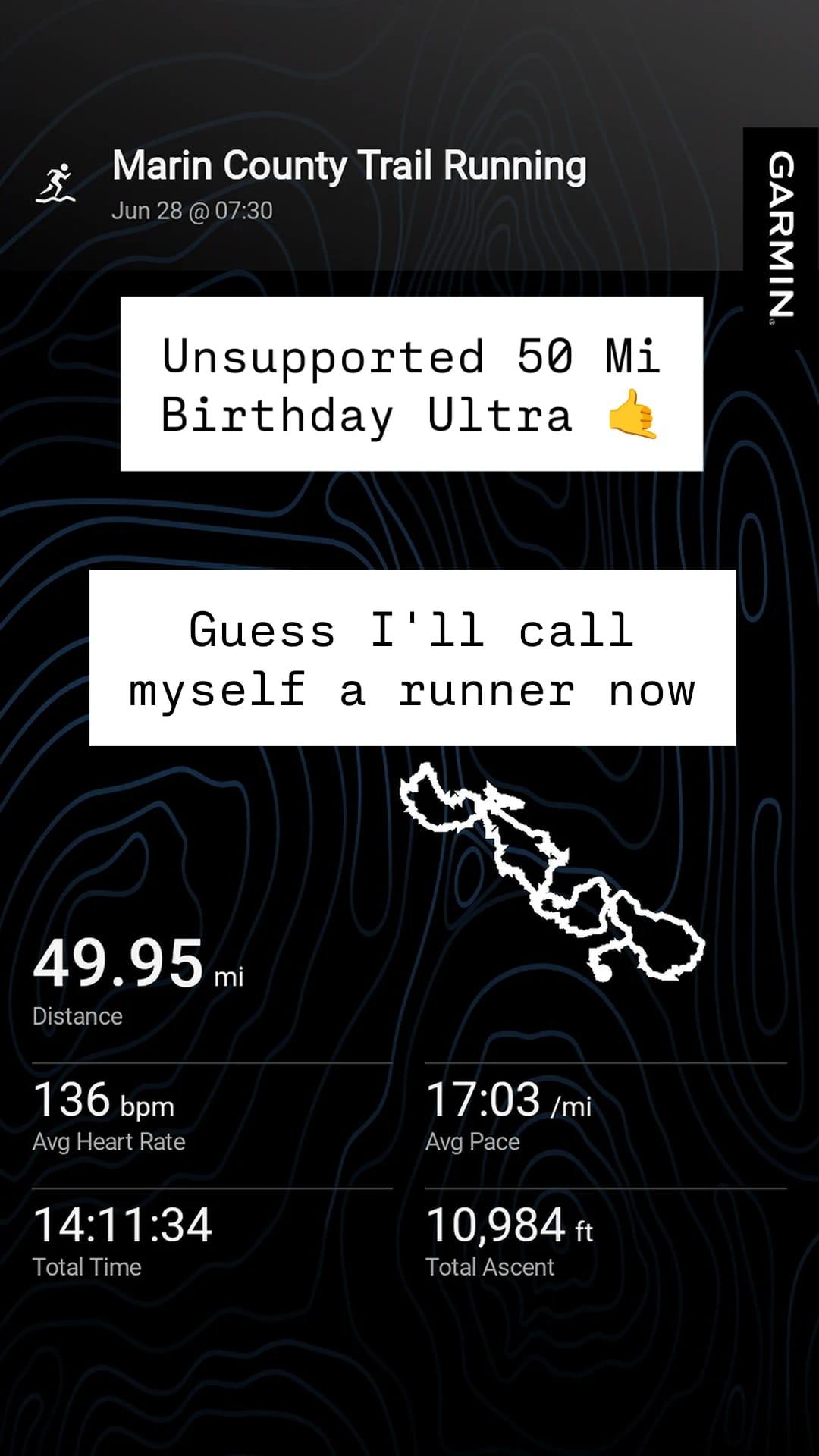
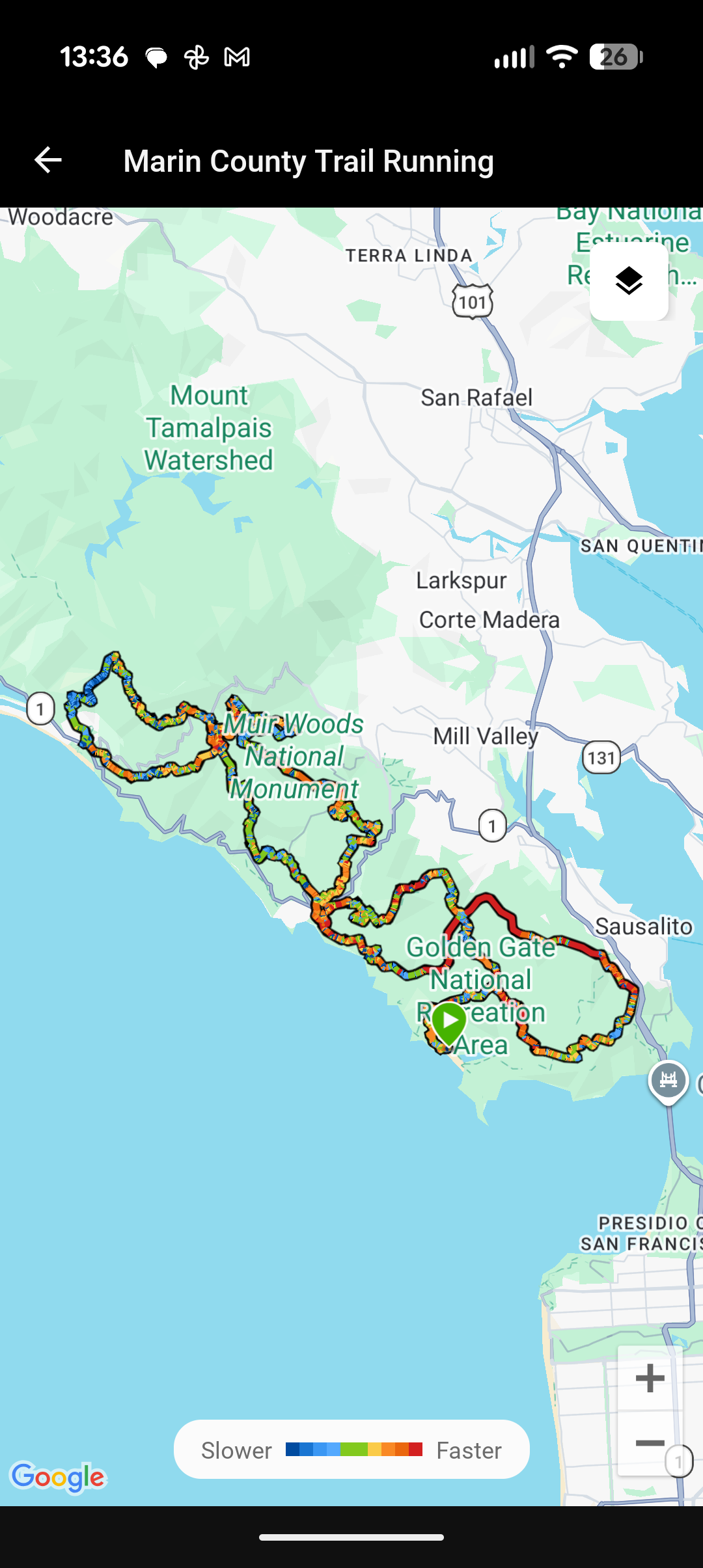
I got it.
I did the official Marin 50 Mile Ultra course.
But I did it unsupported, so I carried my own food/water.
I was much slower than I expected.
The additional 10-15 lbs was more than I expected over the course.
My training runs had me at 13ish mile/minute pace at 25+ miles so I thought I’d be there. Nope.
However, pace adjusted for unsupported conditions (with some AI guesswork) would’ve had me finishing middle of the pack at the last official race.
Not bad for having only started running a little over a year ago.
I feel satisfied in calling myself a runner now.
Dog Dad Update
Kenji is 16 months old. We’re approaching our Adoption Anniversary at the end of July! Time flies.
He recently split his nail on a trail run in the mountains ):

He’s feeling better though. No complications or infections thankfully.
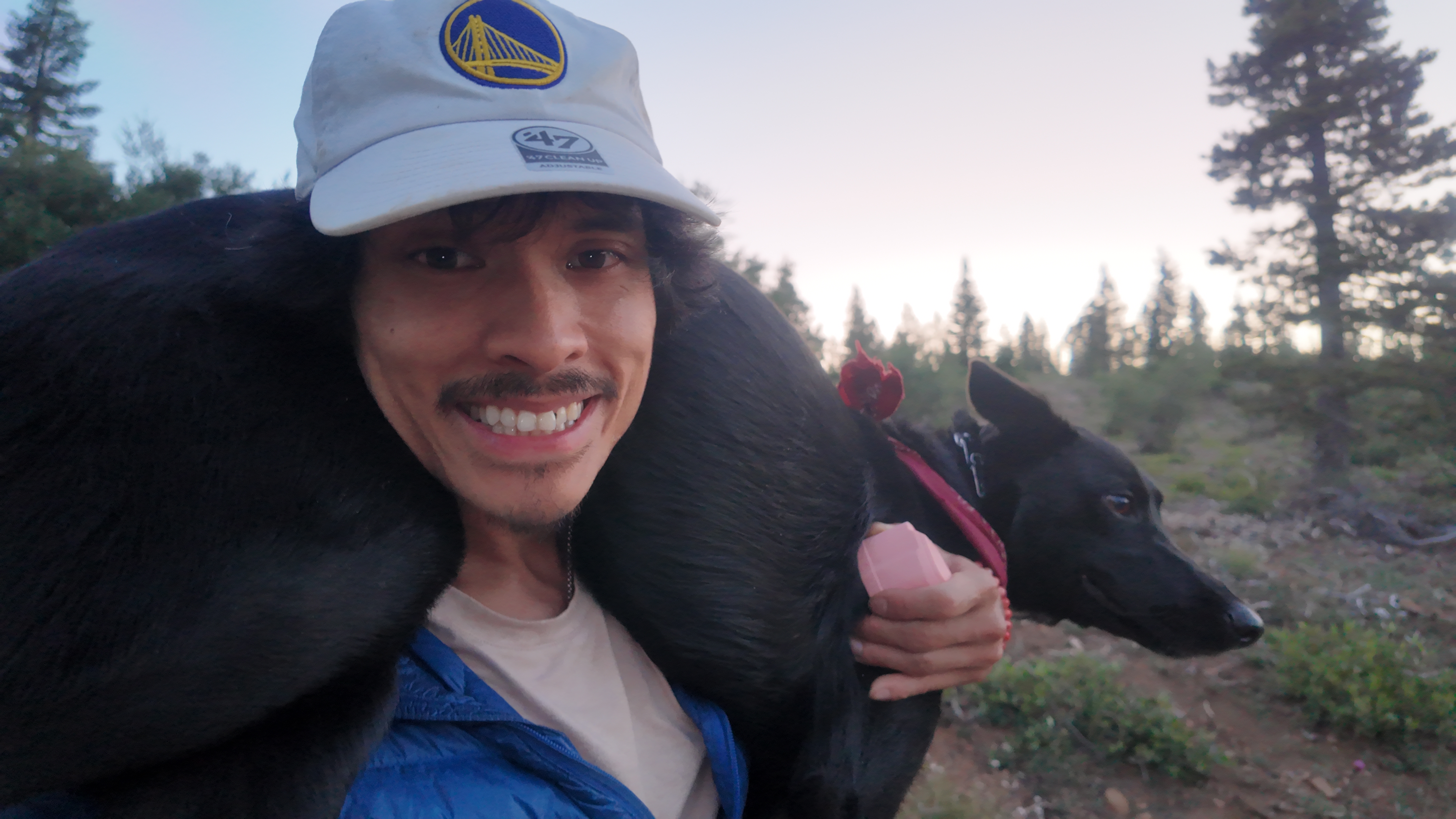
I’m really proud that dog dad training is working. Ken was totally comfortable with being in this position for a short hike out.
I had to do the same thing when he was only 6 months old, and 30 pounds lighter LOL.
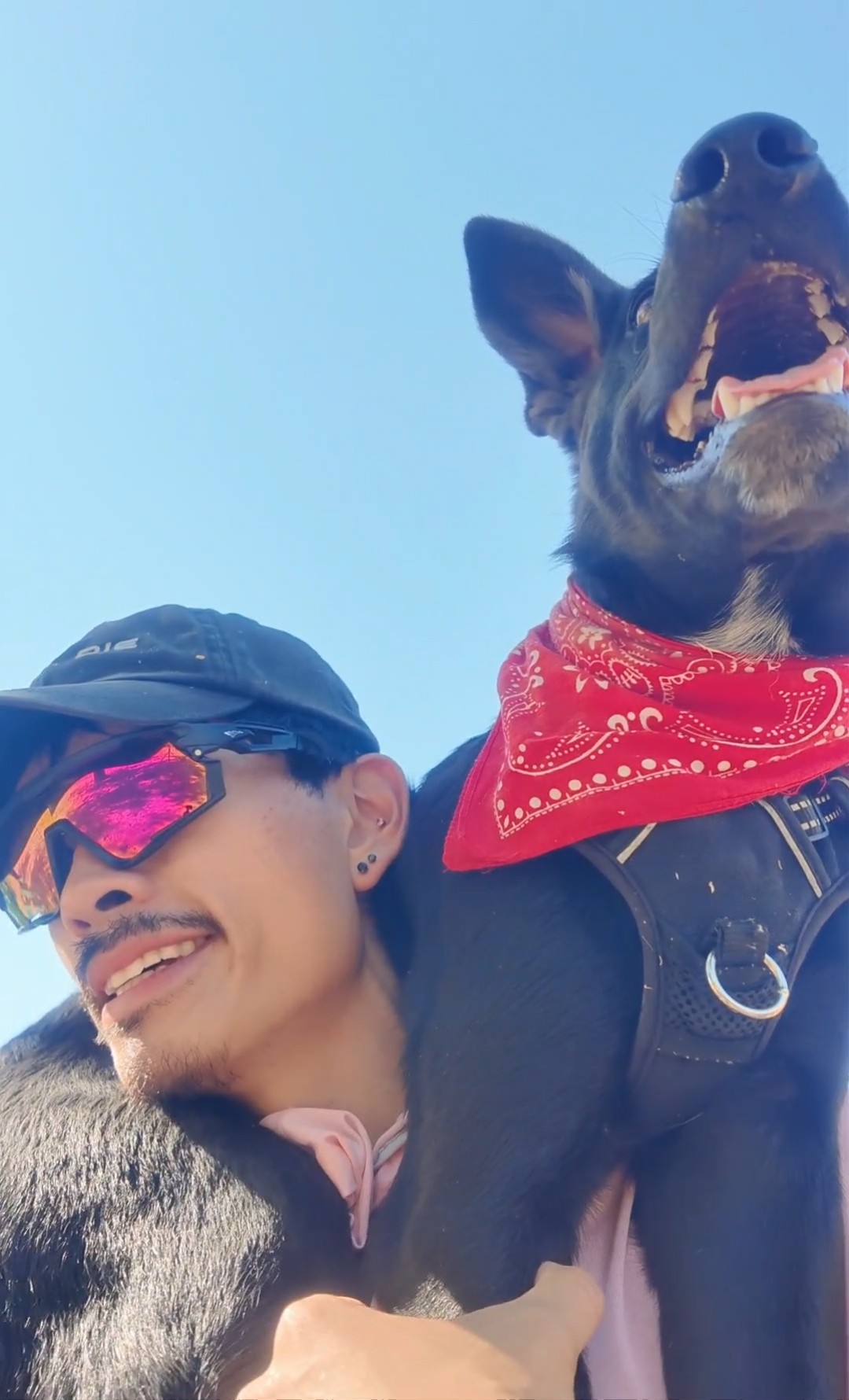
Time really flies.
✌🏼 CULTURE: a lesson from Leonardo’s first workshop
Every week I try to learn something new about the world. Here’s this week’s.
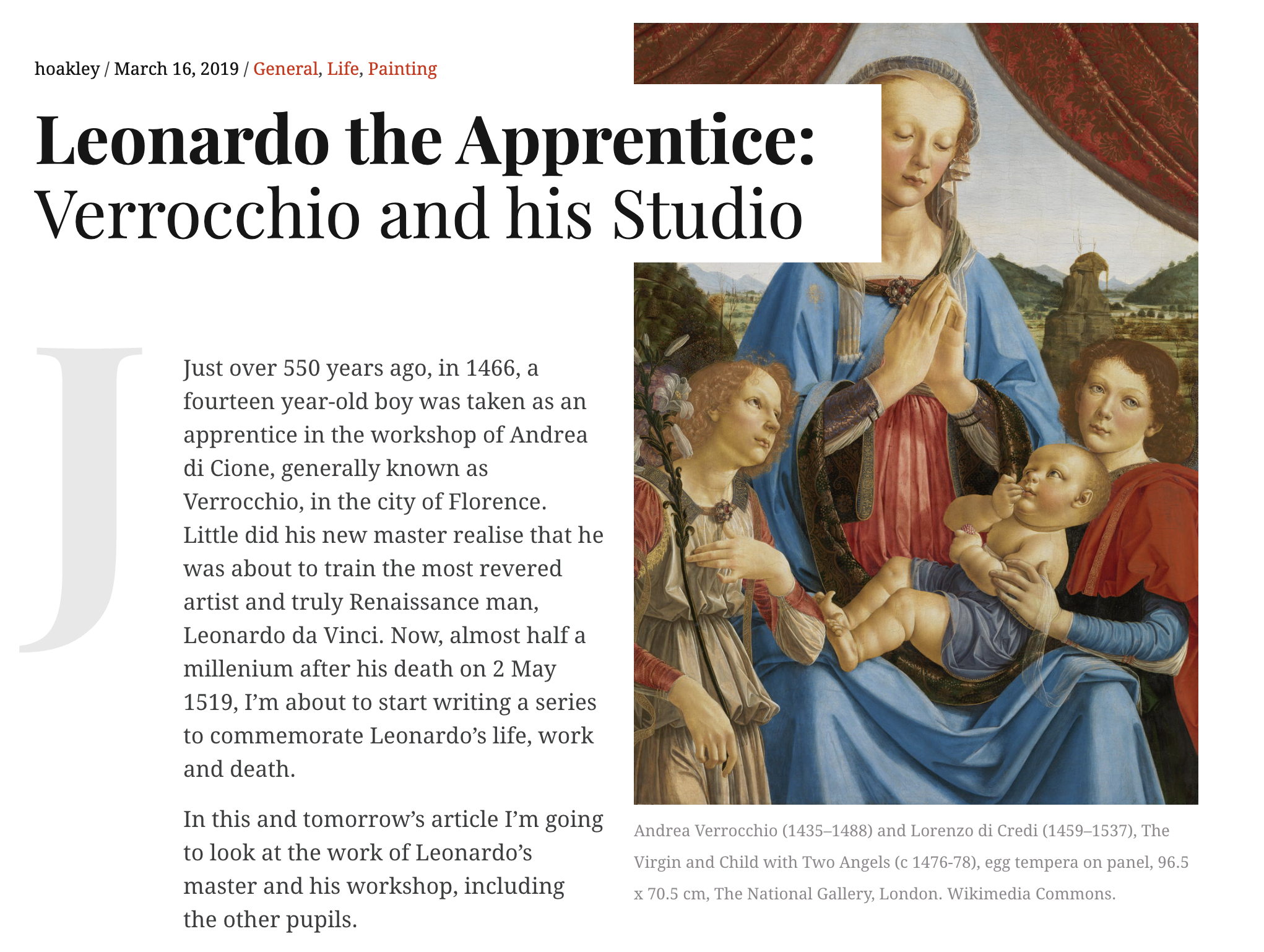
In 15th-century Florence, you did not learn to paint in a school. You learned in a bottega, a workshop, and the greatest of them belonged to Andrea del Verrocchio.
A bottega had no job titles. You ground pigments as a boy. You gessoed panels. You painted the drapery, then a hand, then a face, and the master painted alongside you on the same panel. Sculpture, goldsmithing, engineering, painting, all of it happened under one roof, and the apprentices who could span the whole range became the ones who mattered.
Into Verrocchio’s shop came a boy named Leonardo.
The story, as Vasari tells it, is that Verrocchio let the young Leonardo paint one angel in the corner of his “Baptism of Christ.” The angel came out so alive, so far beyond the master’s own figures, that Verrocchio set down his brush and, they say, never painted again. He kept teaching. He just stopped competing.
The workshop was never about the title on the door. It was a container where knowledge compounded across people, where the apprentice who learned the whole range surpassed the man who taught him, and the master’s genius was to build the room that made it possible.
I share this story, because Fiona Fung (manager of the Claude Code + Cowork teams) from Anthropic recently shared on Lenny’s podcast that she suspects perhaps the software development discipline will evolve more into apprenticeship models on Lenny’s podcast.
I recommend checking it out!
If you are a head of product or engineering staring at your career framework wondering how to name any of this, I want to hear where you are stuck.
—Robert
P.S. If your best domain expert leaving would sink you, the real fix is getting their judgment into a workflow the whole team can query. That is the harness problem we are obsessed with. Hit me up if you want to compare notes.
References
- Boris Cherny. The five archetypes of the future tech team (X)
- Andrew Ambrosino. OpenAI Codex lead on the new shape of product work (Lenny’s Newsletter)
- Cloudflare says AI made 1,100 jobs obsolete, even as revenue hit a record high (TechCrunch)
- Nikhyl Singhal. Why half of product managers are in trouble (Lenny’s Newsletter)
- Anthropic will make Claude Cowork available to users via the cloud (NBC News)
- Daron Acemoglu, David Autor, Simon Johnson. Building Pro-Worker Artificial Intelligence (NBER, 2026)
- Bob Moesta. Jobs To Be Done